Electronics
manufacturing for the
automotive industry
We bring IPC Class 3 assembly, dedicated wire harness lines, and full unit traceability to every automotive programme we run.
What automotive electronics manufacturing actually demands
Automotive buyers evaluate EMS partners differently from other industries. These are the challenges that define whether a manufacturer is genuinely automotive-capable or just claims to be.
Challenge 01
Zero tolerance for field failures
A failed connector or a bad solder joint in a vehicle can trigger a recall costing millions. Automotive electronics demand defect rates measured in parts per million not percent with every failure traceable to its root cause.
01
Zero tolerance for field failures
A failed connector or a bad solder joint in a vehicle can trigger a recall costing millions. Automotive electronics demand defect rates measured in parts per million not percent with every failure traceable to its root cause.
Challenge 02
Extreme environmental demands
Automotive assemblies must operate reliably across temperature extremes from -40°C to +125°C, withstand constant vibration, and resist moisture, chemicals, and EMI for the life of the vehicle, not just the warranty period.
02
Extreme environmental demands
Automotive assemblies must operate reliably across temperature extremes from -40°C to +125°C, withstand constant vibration, and resist moisture, chemicals, and EMI for the life of the vehicle, not just the warranty period.
Challenge 03
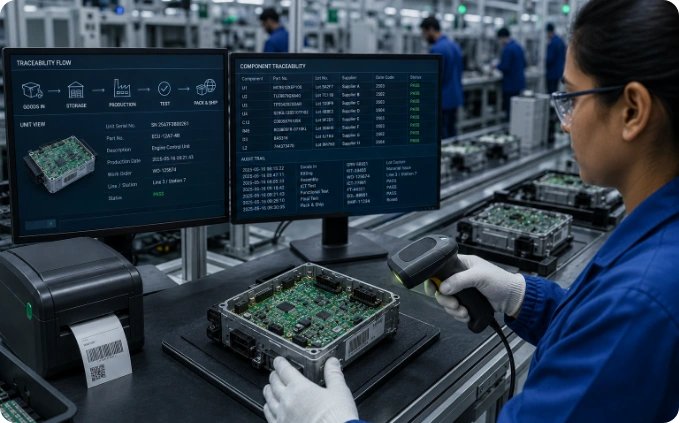
Full traceability for every unit
Every automotive component must be traceable from the component reel through to the finished assembly so that in the event of a field issue, the affected batch can be identified immediately and precisely.
03
Full traceability for every unit
Every automotive component must be traceable from the component reel through to the finished assembly so that in the event of a field issue, the affected batch can be identified immediately and precisely.
Challenge 04
Compliance with IPC Class 3 and AEC standards
Automotive electronics must meet IPC-A-610 Class 3 workmanship standards and AEC-Q200 component qualification requirements, standards that eliminate the shortcuts common in lower-reliability manufacturing environments.
04
Compliance with IPC Class 3 and AEC standards
Automotive electronics must meet IPC-A-610 Class 3 workmanship standards and AEC-Q200 component qualification requirements, standards that eliminate the shortcuts common in lower-reliability manufacturing environments.
Manufacturing solutions built for automotive's demands.
Every service we provide to automotive clients is configured for the precision, traceability, and compliance requirements of the sector not adapted from a generic production process.
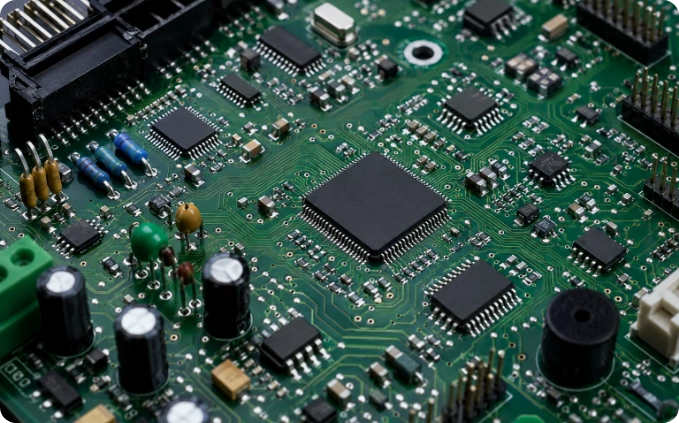
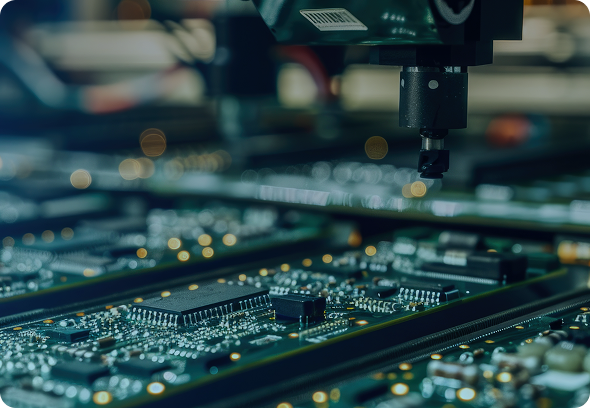
SMT, through-hole, and mixed-technology PCB assembly to IPC-A-610 Class 3 - the highest workmanship standard for electronics requiring long service life and zero tolerance for field failures.
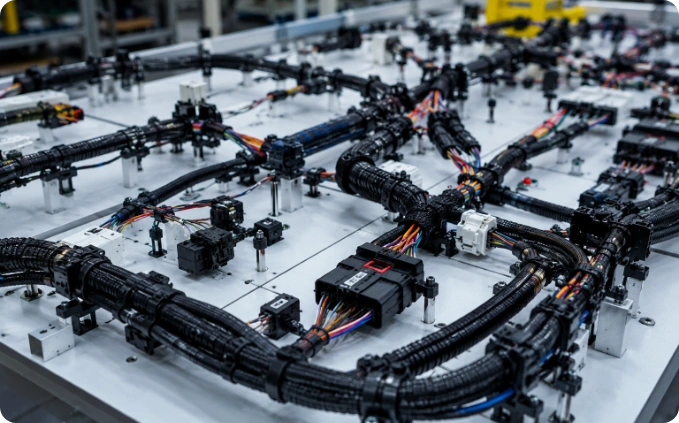
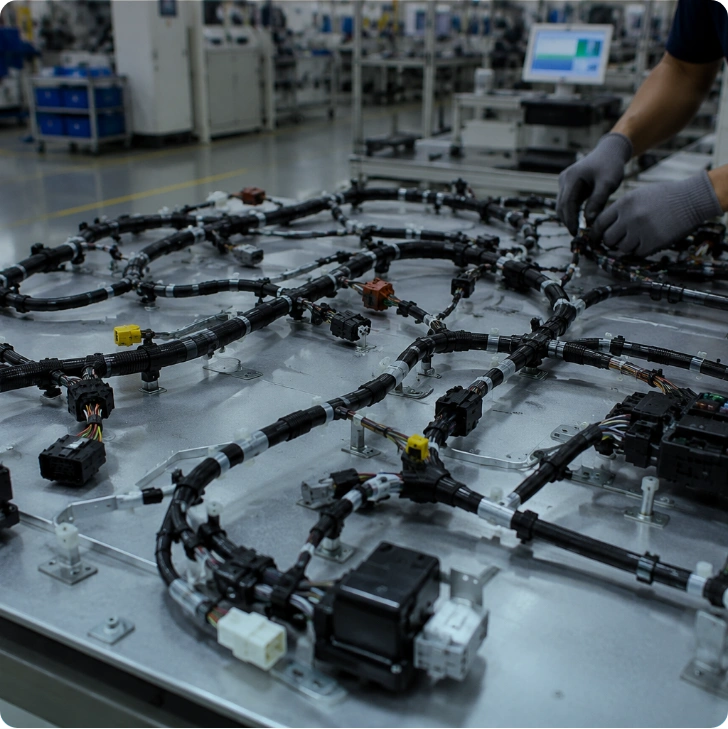
Purpose-built wire harness assembly lines with CFM on every crimp, 100% continuity and HiPot testing, and full unit traceability engineered for the vibration and thermal demands of in-vehicle environments.
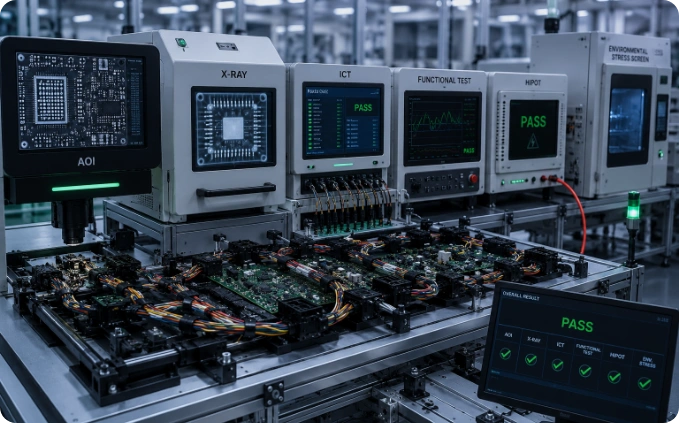
AOI, X-ray, ICT, functional test, HiPot, and environmental stress screening applied across every automotive assembly to verify reliability under the operating conditions your product will actually face in service.
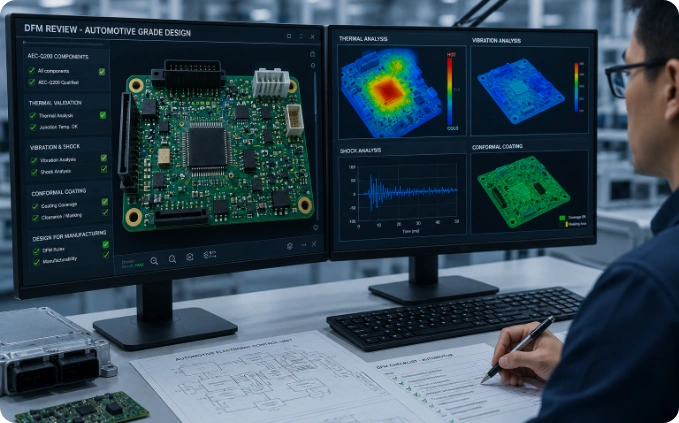
PPAP-aware NPI process with structured iteration cycles, first article inspection, and pilot production runs designed to validate your product against automotive quality requirements before full production release.
Component-level traceability from goods-in to finished assembly with serialised records maintained throughout, giving you the audit trail needed for field investigations and regulatory compliance.
SMT, through-hole, and mixed-technology PCB assembly to IPC-A-610 Class 3 - the highest workmanship standard for electronics requiring long service life and zero tolerance for field failures.
Purpose-built wire harness assembly lines with CFM on every crimp, 100% continuity and HiPot testing, and full unit traceability engineered for the vibration and thermal demands of in-vehicle environments.
AOI, X-ray, ICT, functional test, HiPot, and environmental stress screening applied across every automotive assembly to verify reliability under the operating conditions your product will actually face in service.
PPAP-aware NPI process with structured iteration cycles, first article inspection, and pilot production runs designed to validate your product against automotive quality requirements before full production release.
Component-level traceability from goods-in to finished assembly with serialised records maintained throughout, giving you the audit trail needed for field investigations and regulatory compliance.
The standards that govern automotive electronics manufacturing
Every automotive programme we run is aligned to the relevant industry standards so you can be confident that every assembly meets the requirements your customers and regulators expect
ISO 13485 — Quality
ISO 13485 — Quality
The highest PCB assembly workmanship standard applied to all automotive builds. Class 3 requires greater inspection rigour, tighter tolerances, and zero tolerance for defects that would be acceptable in lower-reliability applications.
AEC-Q200 component qualification
AEC-Q200 component qualification
Component qualification standard for passive components used in automotive electronics ensuring every component in your BOM meets the temperature and reliability requirements of in-vehicle environments.
IPC/WHMA-A-620 Class 3
IPC/WHMA-A-620 Class 3
Wire harness and cable assembly acceptability standard for Class 3 applications governing crimp quality, insulation protection, routing, and mechanical integrity for in-vehicle harness assemblies.
RoHS compliance
RoHS compliance
All automotive assemblies built to RoHS compliance requirements restricting hazardous substances and meeting the environmental compliance obligations of global automotive markets.
ISO 9001 & 14001
ISO 9001 & 14001
Our certified quality and environmental management systems underpin every automotive programme providing the process discipline, documentation control, and continuous improvement culture automotive OEMs require.
PPAP awareness
PPAP awareness
Our NPI and pilot production process is structured to support PPAP (Production Part Approval Process) requirements providing the documentation and validation evidence automotive supply chains demand.
ISO 13485 — Quality
The highest PCB assembly workmanship standard applied to all automotive builds. Class 3 requires greater inspection rigour, tighter tolerances, and zero tolerance for defects that would be acceptable in lower-reliability applications.
AEC-Q200 component qualification
Component qualification standard for passive components used in automotive electronics ensuring every component in your BOM meets the temperature and reliability requirements of in-vehicle environments.
IPC/WHMA-A-620 Class 3
Wire harness and cable assembly acceptability standard for Class 3 applications governing crimp quality, insulation protection, routing, and mechanical integrity for in-vehicle harness assemblies.
RoHS compliance
All automotive assemblies built to RoHS compliance requirements restricting hazardous substances and meeting the environmental compliance obligations of global automotive markets.
ISO 9001 & 14001
Our certified quality and environmental management systems underpin every automotive programme providing the process discipline, documentation control, and continuous improvement culture automotive OEMs require.
PPAP awareness
Our NPI and pilot production process is structured to support PPAP (Production Part Approval Process) requirements providing the documentation and validation evidence automotive supply chains demand.
Why automotive teams choose us?
There are many EMS companies that claim to serve automotive. Here's what makes us genuinely automotive-capable.
Wire harness is a core capability not an add-on
Wire harness assembly represents a significant share of our business. We have dedicated harness lines, IPC/WHMA-trained assemblers, and decades of automotive harness experience not a shared capability bolted on to a PCB house.
IPC Class 3 on every automotive build
Class 3 isn't a premium option with us, it's the standard for automotive programmes. Every assembly, every inspection, every test is conducted to Class 3 requirements from day one.
PCB assembly + wire harness + box build under one roof
Your complete automotive electronic system — boards, harnesses, and enclosures built by one accountable partner. No handoffs between suppliers, no traceability gaps between manufacturing stages.
Full unit traceability as standard
Component-level traceability maintained throughout every automotive programme giving you the serialised audit trail required for field investigations, warranty claims, and regulatory compliance.
CFM on every crimp not just sampled
Crimp force monitoring validates every single terminal in real time not a statistical sample. In an automotive environment where a failed crimp can trigger a recall, this is non-negotiable.
25+ years of automotive manufacturing experience
Decades of cross-programme automotive experience means your programme benefits from lessons already learned on tooling, component qualification, testing, and the quality standards your customers will audit against.
Why automotive teams choose us?
There are many EMS companies that claim to serve automotive. Here's what makes us genuinely automotive-capable.
Wire harness is a core capability not an add-on
Wire harness assembly represents a significant share of our business. We have dedicated harness lines, IPC/WHMA-trained assemblers, and decades of automotive harness experience not a shared capability bolted on to a PCB house.
IPC Class 3 on every automotive build
Class 3 isn't a premium option with us, it's the standard for automotive programmes. Every assembly, every inspection, every test is conducted to Class 3 requirements from day one.
PCB assembly + wire harness + box build under one roof
Your complete automotive electronic system — boards, harnesses, and enclosures built by one accountable partner. No handoffs between suppliers, no traceability gaps between manufacturing stages.
Full unit traceability as standard
Component-level traceability maintained throughout every automotive programme giving you the serialised audit trail required for field investigations, warranty claims, and regulatory compliance.
CFM on every crimp not just sampled
Crimp force monitoring validates every single terminal in real time not a statistical sample. In an automotive environment where a failed crimp can trigger a recall, this is non-negotiable.
25+ years of automotive manufacturing experience
Decades of cross-programme automotive experience means your programme benefits from lessons already learned on tooling, component qualification, testing, and the quality standards your customers will audit against.
Zero-defect wire harness delivery across a 50,000-unit automotive programme.
Problem
An IIoT startup needed to move from validated prototype to 5,000 deployed industrial gateways requiring PCB assembly, IP67 enclosure integration, firmware loading, LoRa module testing, and direct despatch to customer sites across India.
Solution
We managed the full programme - PCB assembly with RF module integration, IP67 box build, firmware flashing and functional test, and direct despatch to customer sites with parallel workstreams compressing the 12-week timeline.
Outcome
5,000 units deployed within 12 weeks. Zero connectivity failures reported post-deployment. Client scaled programme to 20,000 units for the following quarter.
5,000 units · 12 weeks · zero connectivity failures
Ready to discuss your automotive programme?
Tell us about your programme - volumes, standards, timeline. Our automotive team will respond within 24 hours.








.svg)