Surface Mount vs Through-Hole Technology: Which is Right for You?
 10 Mar 2025
  4 min read
 By jinstpvtltd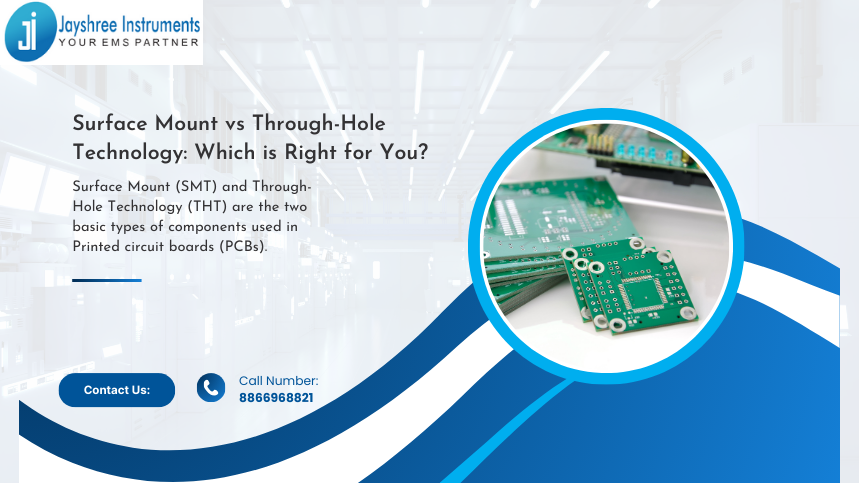
Surface Mount (SMT) and Through-Hole Technology (THT) are the two basic types of components used in Printed circuit boards (PCBs). Since Surface Mount is more dependable and affordable than Through Hole, it is used more often. However, Through Hole Technology offers unique benefits that guarantee its continuous applicability for years to come. Every electronics manufacturer in India utilizes both Surface Mount and Through-Hole Technology and we will compare both of them in this article and help you decide which one is right for you.
Surface Mount Technology (SMT)
Surface Mount Technology (SMT) is the process of physically attaching electrical components to a printed circuit board’s surface. SMT has been widely used in the production of almost all electrical devices since it first gained popularity in the 1980s. SMT is now a crucial part of PCB design due to improved performance and dependability of printed circuit boards, as well as reduced handling and processing expenses.
With SMT, the components are soldered straight onto the board rather than having holes drilled in it. Additionally, SMT components fit on both sides of the board and are smaller. ability to hold more components on a PCB have been made possible by denser, more powerful, and more compact PCBs
Advantages Of Surface Mount Technology
- Increased productivity in manufacturing.
- Increased adaptability in design.
- Improved electronic component performance.
- Smaller for electronic gadgets.
- Design that complies with EMC.
- Auto-placement is automatically corrected.
- Lower total cost.
- Reliable performance even when there is shaking.
- Reduced waste
- Shorter lead time.
Disadvantages Of Surface Mount Technology
- Problems occur when exposed to harsh environments
- Poor defense against environmental and thermal stress.
- Not appropriate for testing small circuits.
- Hard to inspect
- Damage to components is more likely.
- There is less power available.
- more costly to produce in small amounts.
Through Hole Technology (THT)
During the through-hole mounting process, component leads are inserted into drilled holes in a bare PCB. Through-hole technology was the industry standard configuration approach prior to the introduction of SMT in the 1980s. Many people think that THT will become outdated since Surface Mount is more cost-effective and efficient.
The Through Hole approach has proven to be helpful in the era of SMT, offering a variety of advantages and specialized implementations, despite its gradual decline in ratings. The most significant benefit of through-hole technology is its durability, and annular rings currently provide a long-lasting connection.
Advantages of Through Hole Technology
THT is perfect for mechanically stressed components like transformers and connectors because it provides better mechanical connections than SMT. Soldering components by hand is made easier by the wide spacing between the holes. THT components are also readily interchangeable, which makes them perfect for testing and prototyping.
THT components work best in durable products that need strong interlayer bonds. Compared to SMT components, which are solely secured in place by solder on the board’s surface, THT connections allow constituents to withstand greater environmental stresses.
Disadvantages of Through Hole Technology
Using Through Hole requires drilling holes in the bare PCB, which is expensive and time-consuming. As the drilled holes must pass through every layer, THT further limits the configuration area that may be accessed on multi-layered boards. THM is extremely expensive for the majority of applications since its constituent configuration levels are significantly lower than those of surface mount.
Additionally, compared to SMT’s reflow ovens, THT requires the use of wave, selective, or manual soldering techniques, all of which are notably less reliable and efficient. Most significantly, SMT needs soldering on one side of the board, whereas THT requires soldering on both sides.
Which one is right for you?
It can be difficult to choose the best setup technique provided by PCB layout design service to make your board come to life. Surface mount technology is used by more than 90% of PCBs nowadays, but which is the best choice for you? Overall, surface mounting outperforms through-hole technology in terms of pricing and efficiency. It allows for a high component density and provides a lightweight architecture.
However, THT mounting will remain necessary due to special mechanical, electrical, and thermal implications, guaranteeing its continuous relevance for some time to come.